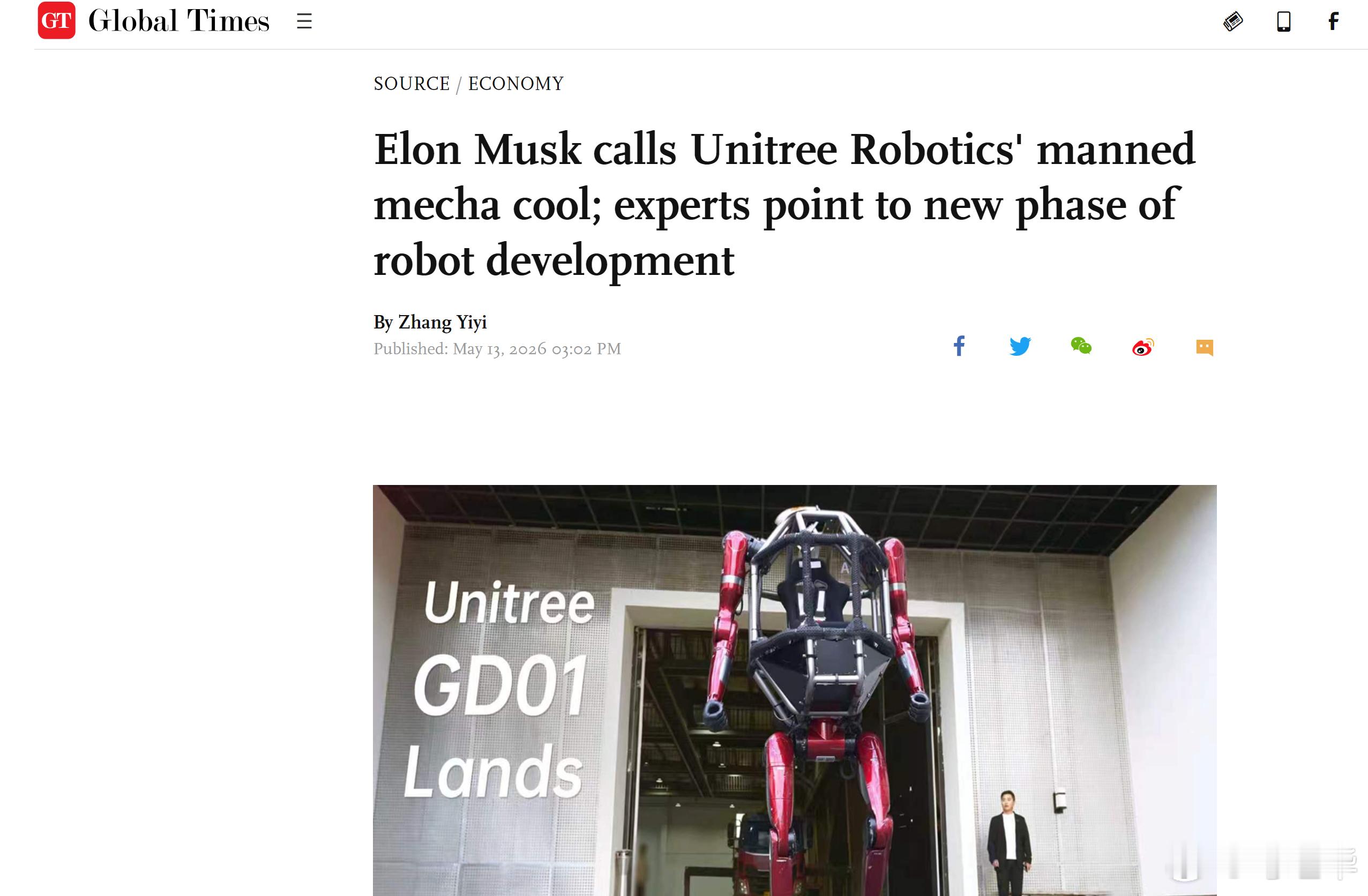
Ma Jihua, a veteran tech insider, told the Global Times that "China is the only country in the world with all major industrial categories. Capabilities in high-performance motors, reducers, sensors, batteries and carbon-fiber materials are all very strong. With such a mature supply chain, companies can rapidly source components, accelerate product iteration, and significantly reduce development costs."
资深科技业内人士马继华告诉《环球时报》,“中国是世界上唯一拥有所有主要工业类别的国家。高性能电机、减速器、传感器、电池和碳纤维材料的能力都非常强大。有了如此成熟的供应链,企业能够快速采购零部件,加快产品迭代,并显著降低开发成本。”
"As long as there is creativity, China can provide the technologies, components and manufacturing capabilities needed to turn ideas into reality," Ma said.“只要有创造力,中国就能提供将想法变为现实所需的技术、零部件和制造能力,”马说。
Among industrial robots used in the global electronics industry, 64 percent are installed in China, while Chinese manufacturers supply 59 percent of the sector globally. In the metal and machinery industry, Chinese robot suppliers have a domestic market share of 85 percent, underscoring China's growing strength across key robotics manufacturing sectors, according to a report by the International Federation of Robotics on May 5.在全球电子工业中使用的工业机器人中,64%安装在中国,而中国制造商供应了全球59%的行业。根据国际机器人联合会5月5日的报告,在金属和机械行业,中国机器人供应商的国内市场份额达到85%,凸显了中国在关键机器人制造领域的日益强势。
According to a report by Rest of World, the three non-Chinese companies that made Omdia's list of top-selling humanoid robot producers last year — Figure AI, Agility Robotics, and Tesla — each sold only about 150 units, far trailing their Chinese rivals. In contrast, Chinese firms such as Unitree and Agibot each sold more units than Tesla's overall 2025 production target of 5,000 humanoid robots, which Tesla ultimately did not meet.根据《世界其他地区》的报道,去年入选Omdia畅销类人机器人制造商榜单的三家非中国公司——Figure AI、Agility Robotics和特斯拉——各自仅售出约150台,远远落后于中国竞争对手。相比之下,中国企业如Unitree和Agibot的销量均超过特斯拉2025年总产量目标5000台,而特斯拉最终未能实现。
Ma noted that while the US still has strong research and design capabilities in high-end manufacturing, many products struggle to move beyond the prototype stage or achieve large-scale commercialization. "In China, once a product is developed, companies quickly begin exploring real-world applications. Once applications are found, mass production follows, costs fall rapidly and a new round of iteration begins," he said, adding that this cycle is becoming one of China's biggest advantages in robotics competition.马指出,尽管美国在高端制造领域仍具备强大的研发和设计能力,但许多产品难以突破原型阶段或实现大规模商业化。“在中国,一旦产品开发完成,公司会迅速开始探索现实应用。一旦找到应用,量产随之而来,成本迅速下降,新一轮迭代开始,“他说,这一周期正成为中国机器人竞争中最大的优势之一。The "new landscape" of US-China robotics competition means the rivalry is no longer limited to traditional industrial robots, but is rapidly expanding into embodied AI, humanoid robots and even large-scale manned mechas. The competition is shifting from simply developing smarter AI "brains" to determining who can integrate AI into real-world hardware faster and bring products into large-scale engineering and commercialization, experts said.美中机器人竞争的“新格局”意味着竞争不再局限于传统工业机器人,而是迅速扩展到具身人工智能、类人机器人甚至大型载人机甲。专家表示,竞争正从单纯开发更智能的人工智能“大脑”转向确定谁能更快地将人工智能集成到现实硬件中,并将产品带入大规模工程和商业化。
While the US maintains advantages in frontier AI models, software ecosystems and core algorithms, China is increasingly building strengths on the "physical world" side of robotics through its complete manufacturing system, dense supply chains and rapid commercialization capabilities, Ma said.马说,美国在前沿AI模型、软件生态系统和核心算法方面保持优势,中国则通过完整的制造系统、密集的供应链和快速商业化能力,在机器人“物理世界”领域日益增强优势。
As the robotics industry moves from laboratories into real-world deployment, the capabilities to mass produce, iterate quickly and scale applications at lower cost are becoming key battlegrounds in the next phase of global competition, he said.他说,随着机器人行业从实验室走向实际部署,大规模生产、快速迭代和以更低成本扩展应用的能力正成为下一阶段全球竞争的关键战场。